



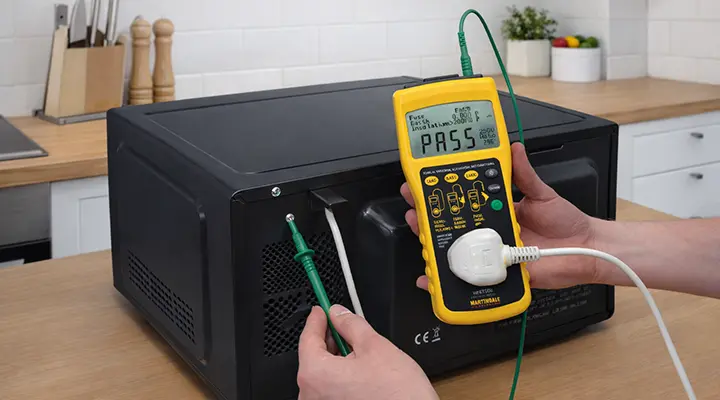
If you supply electrical appliances as part of a tenancy, even something as basic as a kettle or a fridge, you are responsible for making sure they are safe.
Portable Appliance Testing (PAT), is a simple and practical way to check and demonstrate that the electrical items you supply are safe to use.
This guide covers what PAT testing is, what the rules look like across the UK, and how to decide whether to do it yourself or bring in a contractor.
What is PAT Testing?
PAT testing (Portable Appliance Testing), sometimes also called EET (Electrical Equipment Testing), is the process of inspecting and testing portable electrical equipment to check that it is safe to use. A standard PAT test involves two stages:
- A visual inspection, which picks up the majority of potentially dangerous faults, such as damaged cables, cracked casings or burn marks.
- An appliance test using a PAT tester, which checks for issues that you can’t see, such as insulation breakdown or earth continuity failures.
Why PAT Testing matters for landlords
Defective electrical appliances are a significant contributor to house fires and electrical accidents at home. England fire statistics for 2024/25 show that faulty appliances and leads is the second most common cause of fires in homes.
When you supply appliances as part of a tenancy, you take on a responsibility to keep them safe, both when a tenant moves in and throughout their tenancy.
Should an appliance be involved in an injury or fire, the key question will be whether you have taken reasonable steps to identify and manage the risks.
Regular PAT testing gives you solid, documented evidence that you took those steps seriously.
Which appliances are your responsibility?
Your responsibility applies to every appliance you put into the property. It doesn’t matter whether the rental is fully furnished, part-furnished, or unfurnished. If you have supplied it, it is your responsibility to maintain and keep it safe.
Typical items in rental properties that fall under your responsibility include:
- Kitchen appliances – kettles, toasters, microwaves
- White goods – washing machines, fridges, dishwashers
- Entertainment and lighting – televisions, lamps, radios
- Cleaning equipment – vacuum cleaners, steam mops
- Power distribution – extension leads and adaptors
Anything owned by a tenant is not your responsibility. You are only accountable for items you have supplied as part of the letting.
Is PAT testing a legal requirement for landlords?
Across the UK, the key principle is the same: any electrical equipment you provide must be safe.
Electrical safety is usually broken down into two categories:
- Fixed installation – the wiring, sockets, consumer unit/fuse box and light fittings. It is usually evidenced by an EICR (Electrical Installation Condition Report).
- Supplied appliances – the plug-in appliances that you provide as part of the tenancy. These are evidenced through inspection/testing records. A PAT report is the most common way of documenting these checks.
The exact rules for electrical safety checks vary by nation and by property type, but the responsibility to keep supplied equipment safe is consistent.
England
The Electrical Safety Standards in the private and social rented sector require landlords to have the fixed electrical installation inspected and tested by a qualified person at least every five years. Landlords must obtain a report (usually an EICR) from the person conducting the inspection and test, provide it to tenants (and the local council if requested) and complete any repairs within a required timeframe.
PAT testing isn’t always spelt out as a universal requirement for every tenancy. Social landlords in England are legally required to have any portable appliances they provide inspected and tested by a qualified person to ensure that they are safe.
Private landlords are not explicitly required to PAT test, but they are still obliged to ensure any appliances they provide are safe. In practice, if you provide appliances, PAT testing is a straightforward way to show you are meeting that duty.
Wales
In Wales, landlords must have an electrical installation within rented accommodation regularly inspected and tested through a process known as PIT (periodic inspection and testing). This must be carried out by a competent and qualified electrician, who will then issue an electrical condition report (EICR). Landlords must ensure a valid EICR is in place throughout the tenancy and renewed at least every five years.
Pat testing isn’t a legal requirement for landlords in Wales, though it is highly recommended as best practice. All landlords are legally obliged to ensure any appliances they provide are safe at the start and throughout a tenancy, and PAT records provide a practical way to evidence this.
Scotland
Scottish statutory guidance under the Repairing Standard treats electrical safety checks as a two-part inspection:
- Periodic inspection and testing (PI&T) of the electrical installation, which covers fixed wiring, fixtures and fittings
- Inspection and testing of portable appliances provided by the landlord (often described as PAT).
These are commonly documented together as part of a single electrical safety inspection. It must be completed at least every five years.
Northern Ireland
Northern Ireland has introduced specific regulations for private tenancies, requiring landlords to obtain an electrical safety report (often an EICR) from a qualified person at least every five years and to ensure that installations meet electrical safety standards throughout that period.
The NI regulations do not cover plug-in appliances (cookers, fridges, TVs, etc.). However, the Department for Communities recommends landlords regularly carry out PAT on appliances they provide and keep records as good practice.
How often should landlords PAT test?
There is no single legal rule requiring annual testing of everything. HSE guidance is clear that maintenance should be proportionate and risk-based. This should take into account what the appliance is, how it is used, and how likely it is to become faulty.
A practical approach for many landlords is:
- A visual check at every changeover and whenever a tenant reports a problem
- More frequent formal testing for high-use items (kettles, extension leads) than for low-use ones
- Clear, dated records showing what you checked, when you checked it, and what you did about failures
Can Landlords do PAT Testing themselves?
PAT testing does not require an electrician’s qualification. You can carry out PAT testing yourself as long as you can demonstrate that you are competent.
The HSE defines competence as having the training, skills, and knowledge needed to carry out the work safely and correctly. This means that you can carry out PAT tests yourself if you have received training and have appropriate knowledge and understanding of electrical safety and test procedures.
Benefits of doing PAT testing yourself
Beyond the compliance, there are practical and financial advantages to doing PAT testing yourself:
- Faster turnarounds between tenancies
- Better control of standards and records
- Early identification of problems
- Reduced risk in furnished properties
- Cost saving
Tenant changeover periods are already busy with cleaning, inventory checks and repairs. Being able to PAT test during changeovers means you’re not waiting on a contractor to fit you in before a new tenant can move in.
When you run the process yourself, you control the appliance register, the labelling and how results are logged. That makes audits and renewals easier to manage.
HSE notes that the majority of defects are identified via visual inspection, such as damage to plugs, frayed cables, casing cracks or signs of overheating. If you are doing PAT testing yourself, you become better at spotting these issues before they become incidents.
Kettles, microwaves, fridges, lamps, and vacuum cleaners are among the most heavily used and most frequently damaged items in a rental property. A routine check catches problems early, reduces nuisance faults and gives tenants greater confidence in the property.
Cost is one of the biggest reasons why landlords consider doing PAT testing themselves, especially if you manage multiple properties or furnished HMOs.
If you use a contractor, you’ll typically pay around £1 – £3 per item, plus a minimum call-out fee of £40–£80 per visit. Those charges accumulate across multiple properties and add up year after year. A landlord with even a small portfolio could find themselves spending considerable sums on PAT alone.
A PAT testing device is relatively affordable, and getting trained doesn’t require a lengthy qualification. It’s no surprise that a growing number of landlords decide it makes more sense to upskill and handle testing themselves.
Taking an online PAT testing course
For most landlords, the simplest and most cost-effective way to become a competent PAT tester is an online course. You don’t need prior electrical knowledge or years of experience. You just need the right training.
The i2Comply Online PAT Testing Course is designed to be completed fully online and covers PAT testing fundamentals, typical defects and safe processes, with certification on completion.
By the end of the course, you will understand:
- What PAT testing is
- What UK law says about PAT testing
- The basic principles of how electricity works
- How to prepare for PAT testing
- How to carry out the three types of checks recommended by HSE
When to outsource PAT testing instead
Doing PAT yourself is great for many landlords, but it’s not always the right fit. Consider a contractor to carry out PAT testing if:
- you manage high-risk equipment or environments
- you need rapid large-scale testing across many sites at once
- you’re unsure about repairs, retesting after repairs, or borderline failures
- your insurance, contract terms, or licensing conditions explicitly require a third-party provider.
A blended model often works best: landlords handle routine low-risk checks and documentation, and specialists handle higher-risk items, repairs, or periodic portfolio-wide audits.
What happens if you ignore appliance safety?
There is no automatic fine for the absence of a PAT test certificate.
That said, if an appliance you supplied causes harm, a fire, or property damage, your ability to evidence that you acted responsibly becomes critical. Without it, you could face:
- Enforcement action from the local authority
- Claims for compensation from affected tenants
- A voided landlord insurance policy
- Substantial penalties where HMO licensing is involved
Keeping on top of appliance safety through PAT testing is one of the most effective ways to limit your exposure and to demonstrate that both you and your tenants’ interests have been properly looked after.
Final thoughts
PAT testing is one of the most practical steps a landlord can take to manage appliance safety. Whether or not it is explicitly required in your specific situation, a clear record of regular testing is strong evidence that you have taken your responsibilities seriously.
If you want to start carrying out PAT testing yourself, the i2Comply Online PAT Testing Course is a great starting point. Getting trained is straightforward and for landlords with more than one property, the investment typically pays for itself quickly.
