 Price
Price£17.50 + £3.50 VAT
Approximate course duration: 1 hourThis online PUWER Awareness training course provides an introduction to the Provision and Use of Work Equipment Regulations 1998 (PUWER). Learners will gain an understanding of employer and employee responsibilities, common hazards associated with work equipment, and the measures required to use equipment safely. The course takes approximately 1 hour to complete. Price
Price£25.00 + £5.00 VAT
Approximate course duration: 3 hoursThis online Health and Safety training for Employees course provides essential knowledge to help employees work safely and confidently in any workplace. It covers the fundamentals of health and safety law, the responsibilities of employers and employees, and the importance of reporting incidents and near misses. Learners will gain a clear understanding of risk assessment, including how hazards are identified and controlled, the role of PPE, safety signage and emergency planning. Price
Price£17.50 + £3.50 VAT
Approximate course duration: 2 hoursOur online banksman training course equips individuals with the knowledge needed to prevent accidents that involve moving vehicles and plant in the workplace. This Banksman training is relevant for individuals who work in industries such as construction, warehousing, logistics, manufacturing, waste management, agriculture, and any other environment where vehicles and mobile plant operate. Price
Price£17.50 + £3.50 VAT
Approximate course duration: 2 hoursThis DSEAR training course helps individuals understand the risks of dangerous substances and explosive atmospheres in the workplace. It explains control measures that must be in place to keep workers safe and provides general safety precautions workers can use when working with dangerous substances. Price
Price£17.50 + £3.50 VAT
Approximate course duration: 1 hourThis Sexual Harassment Training course explains what sexual harassment is, outlines the law on sexual harassment, and describes different routes you can take to deal with the problem. Once you have completed this course you will be able to recognise sexual harassment in the workplace, know who to report it to, and understand your responsibility in promoting a positive working environment. Price
Price£17.50 + £3.50 VAT
Approximate course duration: 1-2 hoursThis Abrasive Wheel online training course will advise you of the hazards you may encounter when using abrasive wheels and the precautions that you need to take to prevent accidents and injury from occurring when using them.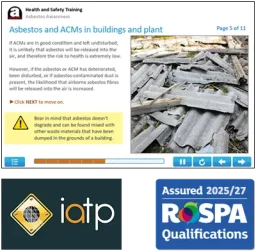 Price
Price£17.50 + £3.50 VAT
Approximate course duration: 2 hoursThis IATP approved online Asbestos Awareness training which complies with the Control of Asbestos Regulations 2012 provides learners with the information needed to avoid work that may disturb asbestos or bring you in contact with asbestos and the risks associated with Asbestos Containing Material (ACM).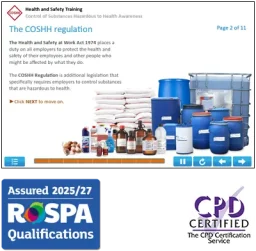 Price
Price£17.50 + £3.50 VAT
Approximate course duration: 1 hourThis COSHH online training course is designed to give workers knowledge of the risks of hazardous substances and the control measures needed to ensure that they understand how to work safely. Price
Price£17.50 + £3.50 VAT
Approximate course duration: 1 hourThis online Cyber Security Awareness training will help you to understand the potential impact of common cyber threats. It outlines safe behaviour on the Internet and identifies what steps you can take to protect yourself and your organisation from cyber-attacks.
DISCOUNTS
Discounts Available For Bulk Purchases
| No. of total licenses | % saving |
|---|---|
| 1 - 9 | - |
| 10 - 19 | 10% |
| 20 - 49 | 20% |
| 50 - 99 | 25% |
| 100 - 199 | 30% |
| 200 - 499 | 40% |
| 500 - 999 | 50% |
| 1000 + | 60% |
For 200+ licences, please email us at sales@i2comply.com or call us on 0333 577 5016.
Manufacturing & Engineering Online Courses

Online Health & Safety Training for Manufacturing & Engineering
i2Comply provides online health and safety and compliance training for individuals, businesses and organisations across the manufacturing sector. Our courses cover key workplace risks, including machinery and work equipment, hazardous substances, manual handling, noise and vibration, working at height and other essential areas of workplace safety.
Our courses are CPD-certified and, depending on the course, IIRSM-approved, IATP-approved or RoSPA-assured. Each self-paced course combines professional audio narration, interactive content and assessments to help learners understand and retain key information.
Online training makes it easier to provide consistent training across your workforce, including employees working at different locations or on shift patterns. Learners can complete their training at a time and place that suits them, wherever they have internet access.
Our standard course licences don’t expire, so you can purchase training now and allocate it when required. Training a larger manufacturing team? Get in touch for a quote tailored to your needs.
The benefit of choosing i2Comply
Our training course licences don’t expire, so you can purchase now and they’ll be available whenever you need them.
We also offer annual licences as a cost effective way to provide training for a large number of learners – just call us on 0333 577 5016 to discuss your requirement.
Click on the categories on the left or browse through our range of courses below.
Click on the categories on above or browse through our range of courses below.
DISCOUNTS
Discounts Available For Bulk Purchases
| No. of total licenses | % saving |
|---|---|
| 1 - 9 | - |
| 10 - 19 | 10% |
| 20 - 49 | 20% |
| 50 - 99 | 25% |
| 100 - 199 | 30% |
| 200 - 499 | 40% |
| 500 - 999 | 50% |
| 1000 + | 60% |
For 200+ licences, please email us at sales@i2comply.com or call us on 0333 577 5016.
Single sign-on (SSO)
Our LMS can be configured to authenticate with your systems, so your users don’t need to remember additional passwords or usernames.
Competence Assurance
Our integrated software environment helps you to plan, develop and monitor enterprise capability and compliance, to minimise the risk of incidents and non-compliance.
Bespoke Online Training
We believe that a desire to acquire new knowledge and skills is the most powerful motivator for most individuals - not gimmicks or tricks.
Call us on 0333 577 5016 for more information or complete the contact form and we'll call you back.
