

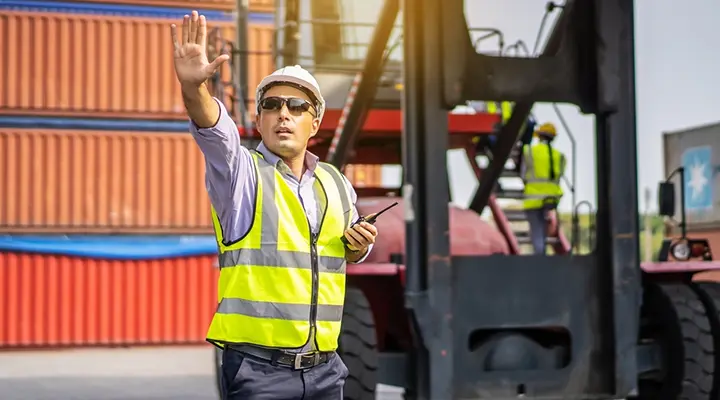


The terms banksman and traffic marshal are often used interchangeably, which can cause confusion about whether they are different roles. In many workplaces, particularly on construction sites, warehouses, logistics yards, and industrial sites, both terms are used to describe a worker responsible for safely guiding vehicles and plant machinery during manoeuvres.
For most workplaces, there is little practical difference between a banksman and a traffic marshal. Both roles are responsible for helping vehicles manoeuvre safely and reducing the risk of workplace transport accidents.
The main difference is usually terminology rather than responsibility. Some employers prefer the term banksman, while others use traffic marshal. In certain environments, a traffic marshal may have wider traffic management responsibilities in addition to guiding vehicles. Both roles rely on clear communication, often using recognised hand signals to direct drivers safely. To learn more about standard signalling methods, see our article Banksman Hand Signals: The Essential Guide for Safe Vehicle Manoeuvring.
What is a banksman?
A banksman is a trained worker responsible for safely guiding vehicles and plant machinery during manoeuvres such as reversing, turning, loading, and unloading. Their role is to help prevent collisions, protect pedestrians and workers, and ensure vehicle movements are carried out safely.
Banksmen are commonly used on construction sites, warehouses, logistics yards, farms, ports, and industrial sites where drivers may have restricted visibility or operate close to people and structures.
If you’re unfamiliar with the role, read our guide to What Is a Banksman? Duties, Responsibilities and Legal Requirements.
What is a traffic marshal?
A traffic marshal is a trained worker responsible for managing vehicle movements and maintaining workplace transport safety. In many industries, particularly construction, warehousing, logistics, and industrial environments, the terms traffic marshal and banksman are often used interchangeably because the roles share many of the same responsibilities.
Traffic marshals help ensure vehicles, plant machinery, pedestrians, and site workers can operate safely in the same area. Their duties may include directing vehicle movements, controlling access and exit routes, monitoring traffic flow, and helping drivers manoeuvre safely in restricted or high-risk environments.
Banksman vs Traffic Marshal: Comparison
| Banksman | Traffic Marshal |
|---|---|
| Guides vehicle manoeuvres | Guides vehicle manoeuvres |
| Uses recognised hand signals | Uses recognised hand signals |
| Often focused on a specific vehicle movement | May oversee wider traffic management activities |
| Common on construction and industrial sites | Common on construction sites, logistics yards and industrial facilities |
| Helps drivers manoeuvre safely in restricted areas | May also manage vehicle routes and pedestrian segregation |
Why proper Banksman Training is essential
Workplace transport remains one of the leading causes of fatal and serious injuries in UK workplaces. According to the Health and Safety Executive (HSE) statistics, dozens of workers are killed and thousands are injured each year in incidents involving moving vehicles and plant machinery.
Many of these accidents occur when untrained workers attempt to guide vehicles without understanding the risks involved. Helpful colleagues have been seriously injured, crushed, or even killed while trying to assist drivers during reversing and manoeuvring operations without the training and competence required of a banksman.
A banksman performs a safety-critical role and should never be simply “someone helping out”. Employers must ensure that banksmen are properly trained, competent, and able to communicate effectively with drivers using recognised signalling methods.
Before appointing a banksman, employers should also carry out a suitable risk assessment to determine whether a banksman is required and what control measures are needed to ensure vehicle movements can be carried out safely. Proper planning, training, and supervision can help prevent avoidable accidents and improve workplace transport safety.
Banksman vs Traffic Marshal: Key Takeaways
In most workplaces, there is little practical difference between a banksman and a traffic marshal. Both roles are responsible for helping vehicles and plant machinery manoeuvre safely, reducing the risk of workplace transport accidents, and protecting workers, pedestrians, and property.
While some organisations use different job titles, the responsibilities often overlap significantly. Regardless of whether the role is called a banksman or traffic marshal, workers should receive appropriate training, operate within a safe system of work, and be competent to carry out their duties safely.
For those looking to gain the necessary skills and knowledge, a recognised Banksman Training Course can help workers understand safe vehicle guidance, standard hand signals, hazard awareness, and workplace traffic management procedures.
Online Banksman Training course
Whether your workplace uses the term banksman or traffic marshal, workers responsible for guiding vehicles should receive suitable training before carrying out safety-critical duties.
Our Online Banksman Training Course provides the theoretical knowledge needed to help workers understand vehicle manoeuvring hazards, workplace transport safety, dynamic risk assessments, communication methods, and recognised hand signals.
The course is suitable for workers operating in construction sites, warehouses, logistics yards, industrial facilities, farms, and other workplaces where vehicles, plant machinery, pedestrians, and workers operate in close proximity.
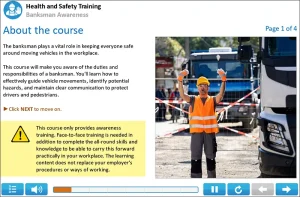
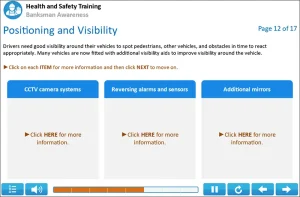
Equip your banksmen and traffic marshals with the knowledge needed to manage vehicle movements safely and effectively. Purchase Online Banksman Training today for just £17.50 per person.