Discounts Available For Bulk Purchases
| No. of total licenses | % saving |
|---|---|
| 1 - 9 | - |
| 10 - 19 | 10% |
| 20 - 49 | 20% |
| 50 - 99 | 25% |
| 100 - 199 | 30% |
| 200 - 499 | 40% |
| 500 - 999 | 50% |
| 1000 + | 60% |
Click on the image below to download the Safeguarding Children Level 2 Online Course Flyer.
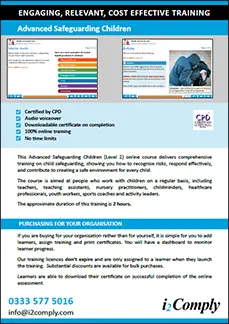
Safeguarding Children Level 2 Online Course
£22.00 + £4.40 VAT
- CPD certified
- Audio voiceover
- Approximate course duration 2 hours
- Downloadable certificate on completion
- 100% online training
Our Safeguarding Children Level 2 training course provides advanced safeguarding knowledge for anyone who works directly with children, young people or families. This CPD-certified online safeguarding children course explains how to recognise signs of abuse, neglect and exploitation, respond appropriately to safeguarding concerns and understand your responsibilities for protecting children from harm.
The course is suitable for professionals who have regular contact with children and require a more in-depth understanding of safeguarding, including teachers, teaching assistants, nursery practitioners, childminders, healthcare professionals, social care workers, youth workers and sports coaches.
Complete the course 100% online in approximately 2 hours, pass the online assessment and download your CPD-certified certificate immediately.
What is Advanced Safeguarding?
Advanced safeguarding builds on introductory safeguarding knowledge and provides a deeper understanding of how to recognise, respond to and report concerns about a child’s safety or welfare. It is particularly relevant to professionals who work directly with children, young people or families and have greater safeguarding responsibilities as part of their role.
If you are concerned about a child and you think they are in immediate danger don’t delay – call the police on 999, or call the NSPCC on 0808 800 5000 straight away.
Please note: Safeguarding Children Level 2 training covers the material included in our Safeguarding Children Level 1 course, with additional in-depth safeguarding content.
Who is Safeguarding Children Level 2 training for?
This Advanced Safeguarding Children course is for anyone who works directly with children, young people or families and has regular contact with children as part of their role.
The course is suitable for professionals in a range of settings, including:
- Teachers and teaching assistants
- Nursery practitioners and childminders
- Healthcare professionals and assistants
- Social care workers and support staff
- Youth workers and community practitioners
- Sports coaches and activity leaders
Reviewed and approved by lead bodies
The training course complies with the Continuing Professional Development (CPD) guidelines and is accredited by the CPD Certification Service.
Safeguarding Children Level 2 course learning outcomes
After completing the Advanced Safeguarding Children course, you will be able to:
- Identify who is responsible for safeguarding children.
- Describe legislation that relates to safeguarding children and what happens when suspected abuse is reported.
- Identify parental/carer issues that can contribute to child abuse.
- Describe several kinds of abuse that children can experience.
- Identify special issues regarding disabled and deaf children.
- Outline what to do if a child discloses abuse or you suspect abuse.
Example course pages
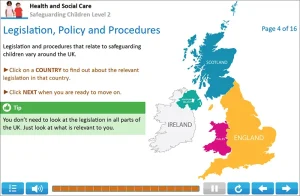
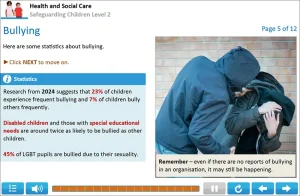
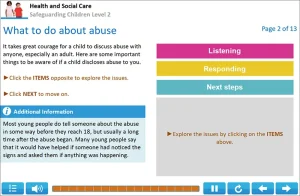
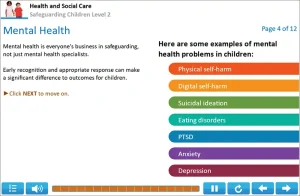
You will find example screens from our Advanced Safeguarding Children online training course below. All of our courses are designed to be simple but informative, to make it easy for you to learn. We incorporate text, images, tables and professional audio throughout to support different ways of learning.
(Click on the example screens below to view)
What does the Safeguarding Children Level 2 course cover?
The online Advanced Safeguarding Children course covers the following 16 topics:
1 – Introduction to safeguarding children
The first topic explains what safeguarding children means. It outlines who abuses children and identifies who is responsible for safeguarding children. The topic also describes the short-term and long-term impact of child abuse.
2 – Legislation, policies and procedures
The second topic introduces fundamental human rights and the rights of a child. It outlines key UK legislation and policies related to safeguarding and explains what happens in different parts of the UK after child abuse has been reported.
3 – About parents and carers
The third topic describes how issues such as drug and alcohol misuse, mental health difficulties, and stress can affect parents’ and carers’ ability to care for children appropriately. It also highlights the importance of early help.
4 – Physical abuse
Topic 4 focuses on the physical abuse of children. It explores definitions and prevalence statistics and identifies the short-term and long-term effects of physical abuse. It also outlines how to recognise possible signs that a child may be at risk of physical abuse.
5 – Emotional abuse
Topic 5 explores emotional abuse and the impact it can have on child victims. This topic covers the definition and prevalence of emotional abuse, its effects on children, and how to recognise the signs that it might be taking place.
6 – Sexual abuse
Topic 6 is about the sexual abuse of children. This topic covers definitions of sexual abuse, its prevalence, the short-term impact and long-term effects on children, and the signs to look out for that can help identify whether a child is being abused.
7 – Neglect
Topic 7 explains what neglect is and outlines the impact it has on a child. This topic covers the definition and prevalence of neglect, four different types of neglect, its impact on children, and the signs that a child is being neglected.
8 – Domestic abuse
Topic 8 explores how domestic abuse between parents can impact children in the household. This topic covers the definition and prevalence of domestic abuse, explains what constitutes domestic abuse and identifies how it affects children. Finally, it outlines the warning signs that a child may have witnessed domestic abuse.
9 – Human trafficking
Topic 9 is about the human trafficking of children. It provides a definition of human trafficking and some reasons why children are trafficked. The topic also explores the relationship between trafficking and abuse, outlines the prevalence of human trafficking in the UK, and identifies signs that a child has been trafficked.
10 – Radicalisation
Topic 10 is about radicalisation and how to prevent children from being radicalised. This topic provides a definition of radicalisation, explores what makes children vulnerable to radicalisation, and identifies signs that a child is being radicalised.
11 – Bullying
Topic 11 defines what constitutes bullying, outlines its prevalence and explains the impact on those who bully, are bullied and who witness bullying. This topic also identifies signs that help recognise when a child is being bullied.
12 – Online issues
Topic 12 is about online issues and how they affect a child’s health and well-being. This topic covers cyberbullying, sexting, online pornography, online grooming, and some new online developments that can be unsafe.
13 – FGM
Topic 13 is about female genital mutilation, also known as FGM, and other harmful practices. This topic explains what FGM means, where it happens, and its prevalence. It also explores the impact of FGM and the signs that a girl may have been subjected to FGM. This topic also explores other harmful practices, including forced marriage, breast flattening, virginity testing, and hymenoplasty.
14 – Special issues around disabled children
Topic 14 is about special issues around disabled children. This topic explores why disabled children are more likely than other children to be abused, the communication barriers that mean disabled children may not get the help they need, and how isolation increases risks for disabled children. It also explains how the signs that a disabled child is being abused can be missed.
15 – Mental Health
Topic 15 is about mental health and safeguarding. This topic explores which children can have mental health problems, the importance of early recognition, how common mental health problems are in children, and how to respond to disclosure.
16 – What to do about abuse
The final topic is about what to do when you suspect a child is, or has been, subject to abuse. This topic covers how to deal with disclosure, how and why you should record abuse, and how to report abuse.
How is the Safeguarding Children Level 2 course assessed?
At the end of the course, there is an assessment, which consists of 26 multiple-choice questions. The questions are generated from question banks, which means the questions are different each time you participate. This makes the training suitable for both initial and refresher training.
Each question includes helpful feedback, allowing you to understand any mistakes and reinforce your learning.
You need to score 80% to pass the assessment. There are no limits on the number of attempts for the course assessment, which allows you to take it multiple times until you feel confident that you have learned the course material.
Safeguarding Children Level 2 course certificate and renewal
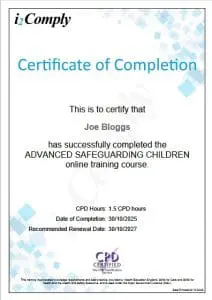 When you have successfully passed the online Advanced Safeguarding Children course assessment, you will be able to download and print your certificate immediately. Your certificate will include the CPD logo and, therefore, you can use it to provide evidence for compliance.
How long is my safeguarding children course certificate valid for?
Your Advanced Safeguarding Children course certificate does not have an expiry date. However, to keep your safeguarding knowledge up to date, we recommend renewing the course every three years. This recommended renewal date will be printed on your certificate.
Course reviews
We value feedback from our learners and welcome you to share your experience with us.
Once you have completed the Advanced Safeguarding Children training course, we’d love to hear your feedback. Please visit our Advanced Safeguarding Children Course Reviews page to get an insight into the quality and effectiveness of our courses.
You can also read reviews of our training on Reviews.io or Google.
What does safeguarding children mean?
Safeguarding children is the process of promoting the welfare of children and protecting them from harm. This includes all procedures designed to prevent injury to a child, including taking actions to protect children from maltreatment, abuse, and neglect, preventing damage to their health or development, ensuring that children receive safe and effective care and taking action to enable all children to have the best outcomes and equal opportunities in life.
Which Safeguarding Children course should I choose?
The right safeguarding course depends on your role and level of responsibility.
Level 1 – Safeguarding Children (Introduction)
Ideal for anyone who may come into contact with children or families, such as admin staff, receptionists, drivers, maintenance or catering staff, volunteers, and anyone working in a setting where children are present.
Level 2 – Safeguarding Children (Advanced)
Designed for professionals who work directly with children or families in their day-to-day roles, like teachers, nursery practitioners, childminders, healthcare assistants, social care workers, youth workers or sports coaches.
Safeguarding Lead (Advanced Responsibilities)
For those with designated safeguarding responsibilities or leadership roles in safeguarding practice, such as designated safeguarding leads (DSLs), managers, supervisors, headteachers, safeguarding officers, clinical leads, or anyone overseeing safeguarding practice in their organisation.
What is cyberbullying?
Cyberbullying is bullying online. Bullies use technology to cause another person harm, distress, or personal loss. They use many techniques, including intimidating text messages, sharing embarrassing images, and setting up a hate site about a particular child. Cyberbullying can feel much worse than other types of bullying because it can be impossible to escape from it, driving some young people to suicide.
Sadly, cyberbullying is very common. 1 in 5 children aged between 10 to 15 in England and Wales experienced online bullying in the year ending March 2023. For more information on cyberbullying and other types of risks children face online, read our article How to keep children safe online.
Book our online Safeguarding Children Level 2 course today
Once you are ready to purchase the Advanced Safeguarding Children online course, simply add the course to your basket by clicking the Add to Basket button and proceed to checkout.
If you would like to purchase for your team, don’t forget to take advantage of our bulk purchase discounts. You can see a list of available discounts on the left-hand side of the page. Discounts are automatically applied at checkout.
Other online UK Health & Social Care courses
Click on the course titles below to learn about other Health & Social Care courses or see a full list of courses here.
- Dementia Awareness Training Course
- Infection Prevention and Control Course
- Safeguarding Adults Course (Level 2)
- The Legal Use of Restrictive Interventions Course
Want to view our entire course offerings? View our training courses on fire safety, health and safety, food hygiene and health & social care.
Frequently Asked Questions
Safeguarding Children Level 2 training provides more in-depth safeguarding knowledge for people who work directly with children, young people or families. It covers how to recognise signs of abuse, neglect and exploitation, respond appropriately to safeguarding concerns and understand your safeguarding responsibilities.
Safeguarding Children Level 2 training is suitable for professionals who have regular contact with children, young people or families and require a more in-depth understanding of safeguarding. This can include teachers, teaching assistants, nursery practitioners, childminders, healthcare professionals, social care workers, youth workers and sports coaches.
Safeguarding Children Level 1 provides introductory safeguarding knowledge for people who may come into contact with children or families. Level 2 is designed for professionals who work more directly with children and require a deeper understanding of recognising, responding to and reporting safeguarding concerns.
Yes. Our Safeguarding Children Level 2 course is accredited by the CPD Certification Service. After successfully completing the course, you can download and print your course certificate.
The Safeguarding Children Level 2 course takes approximately 2 hours to complete and is delivered entirely online.
The course ends with an online assessment consisting of 26 multiple-choice questions. You need to score at least 80% to pass, and there is no limit on the number of attempts.
No. Your Safeguarding Children Level 2 course certificate does not have an expiry date. However, we recommend refreshing your training every three years to help keep your safeguarding knowledge up to date.
Once you pass the online assessment, you can download and print your certificate immediately. Your certificate includes the CPD logo and provides evidence that you have successfully completed the training.
Any additional questions on the course?
Even after reading all the relevant information and answers to questions regarding our safeguarding children training above, you might have some other queries. If so, contact one of our experts by emailing support@i2comply.com or call 0333 5775 017.
We also have a resource centre available to answer FAQs. Please see what questions we’ve previously answered, including replies to questions regarding licences, account settings, discounts, payment options and more.
Request an online training quote
Whether you are looking to train a small team or an entire business, we’re here to help. Let us know your online training requirements and we’ll provide you with a quote.
£22.00 + £4.40 VAT
Discounts Available For Bulk Purchases
| No. of total licenses | % saving |
|---|---|
| 1 - 9 | - |
| 10 - 19 | 10% |
| 20 - 49 | 20% |
| 50 - 99 | 25% |
| 100 - 199 | 30% |
| 200 - 499 | 40% |
| 500 - 999 | 50% |
| 1000 + | 60% |
Related courses
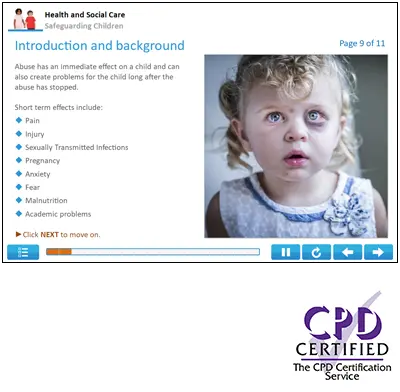
Safeguarding Children Level 1 Online Course
Price£17.50 + £3.50 VAT
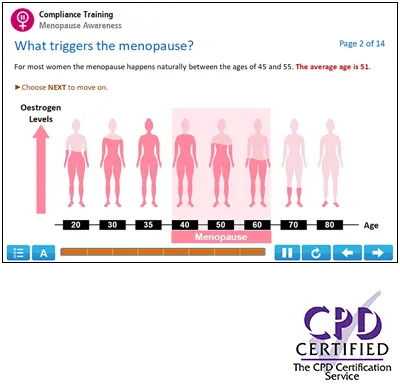
Menopause Awareness Training
Price£17.50 + £3.50 VAT
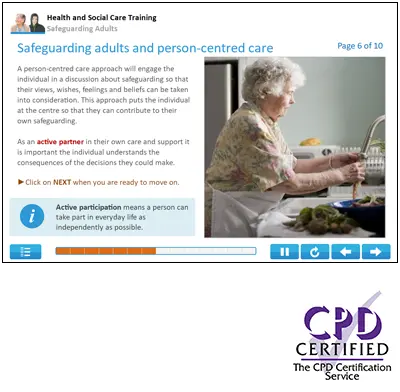
Safeguarding Adults Online Training Course (Level 2)
Price£17.50 + £3.50 VAT
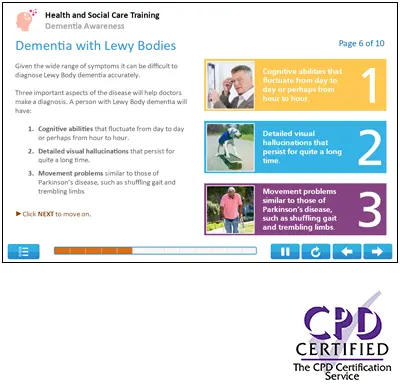
Dementia Awareness Online Course
Price£17.50 + £3.50 VAT
